Cross-Border e-Commerce Acceleration Program (China 🇨🇳)
Unlock the power of China’s e-commerce supply chain to launch your e-commerce business globally.
Mar 9 - 13 2026, Hangzhou + Yiwu

China is the world’s most powerful manufacturing and e-commerce hub. Yet for many international e-commerce sellers, working with China still feels complex, fragmented, and risky. Most sellers know platforms like Alibaba. Many already work with Chinese suppliers. But knowing where to buy is not the same as knowing how the system actually works.
What’s often missing is a system-level understanding of China’s cross-border e-commerce ecosystem - how sourcing, pricing, logistics, platforms, and operations connect in practice.
That gap is exactly why this Cross Border e-Commerce Acceleration Program was created. It is a structured Study Tour and Accelerator designed for e-commerce businesses that want clarity, control, and scalability when working with China.
The program combines:
Focused learning modules
On-site field visits
Real operational scenarios
🎯 The goal is simple: to help participants understand how China’s cross-border e-commerce ecosystem actually operates, so they can make better decisions for their businesses.

Who This Program Is Designed For
This program is designed for:
New e-commerce sellers scaling beyond experimentation
Marketplace operators sourcing from China
Brand owners building international supply chains
It is especially suitable for companies that want to build structured, scalable, and sustainable operations, rather than relying on short-term arbitrage.
What You Will Learn: Core Course Modules

Participants go through a set of carefully designed learning modules that cover the full operational logic of China’s cross-border e-commerce system, including:
1. How China’s E-commerce Ecosystem Is Structured
Participants gain a clear overview of how manufacturing, platforms, logistics, and digital infrastructure fit together — and why China’s system operates at scale.
2. B2B, B2C, and Platform-Based Models
The program breaks down the differences between:
Traditional B2B sourcing
Direct-to-consumer (B2C) models
Platform-led cross-border commerce
Participants learn when each model works - and when it doesn’t.
3. Pricing Logic from EXW to DDP
Rather than focusing only on product cost, the program explains how real pricing is formed, including:
Production cost
Logistics and customs
Taxes and duties
Risk and margin allocation
This helps sellers build transparent and sustainable pricing structures.
4. How Suppliers Think
Participants learn how Chinese suppliers approach:
Minimum order quantities (MOQ)
Customization and private labeling
Quality control
Production timelines
This insight helps avoid misunderstandings and costly negotiation mistakes.
5. Logistics, Customs, and Fulfillment
The program explains how logistics and customs clearance directly affect:
Delivery speed
Customer experience
Scalability and compliance
Participants learn how supply chain design impacts long-term growth.
What You Will See: Field Visits and On-Site Learning

Learning does not stay in the classroom. The program includes carefully selected site visits that allow participants to see how China’s cross-border e-commerce system works in real life. Participants will:
Visit industrial clusters and manufacturers to understand real production capacity
Observe logistics and fulfillment operations to see how goods move across borders
Learn how digital trade and platform infrastructure supports large-scale international commerce
Each visit is designed to answer one key question: Can this work for my business, in my market?
The Real Value for Participating Companies
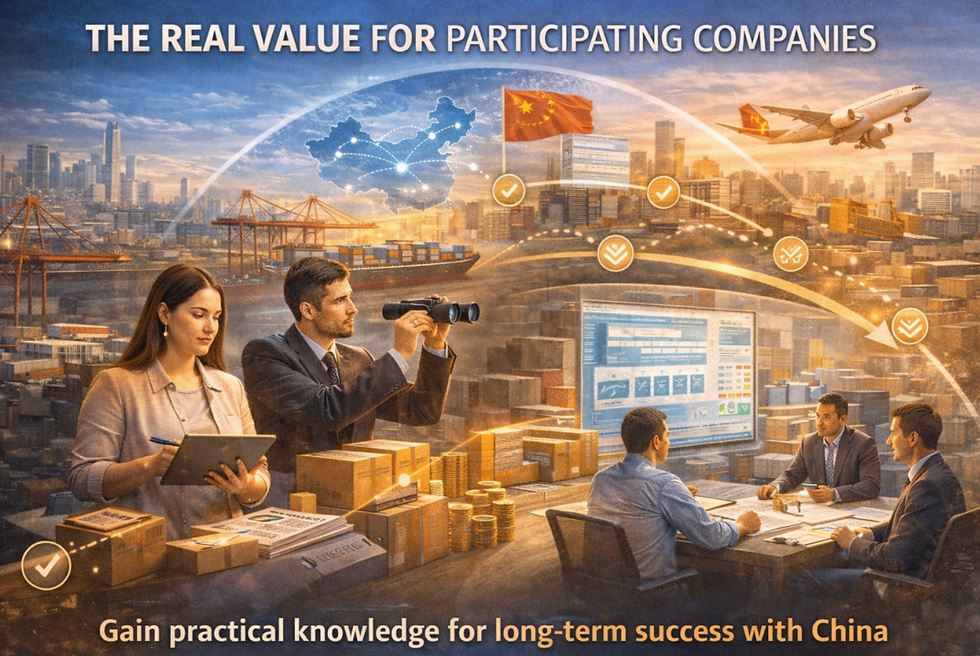
✅ By the end of the program, participating companies gain:
A system-level understanding of China’s cross-border e-commerce ecosystem
Clear criteria for selecting suppliers, platforms, and logistics models
Improved ability to control pricing, delivery timelines, and operational risk
Reduced trial-and-error when entering or scaling in new markets
A realistic roadmap for pilot projects and long-term cooperation with China
This is not academic knowledge. It is decision-making knowledge that can be applied immediately.
From Understanding China to Working With China

Working with China does not have to be confusing or risky- but it does require systemic understanding.
This Study Program is designed to help participants move from fragmented knowledge to clarity, from isolated sourcing to structured execution.
If you want to truly understand China -not just visit it - this program was built for you.